For Bissan
I sit on the balcony of our historic and luxurious hotel room just outside the city of Beirut, up in the mountains, away from the smog and petrol fumes that perpetually choke the city. Here, the air is crisp and clean. Fuchsia Bougainvillea spills over walls and climbs up fences and the scent of pine trees wafts through the air. Below my balcony children play in the sprawling gardens. Fahima, the hotel’s resident donkey, ambles past, prompting squeals of delight from the children. Further in the distance stretches the urban jungle that is Beirut, with its bustling streets and manic traffic. Traditional Ottoman Era and French Mandated houses are nestled between luxurious high-rise apartments and modern office buildings. Chic boutiques and trendy cafes sit alongside bullet riddled walls and twisted barbed wire. The ultimate city of contradictions. Further still, the Mediterranean, glistening in the sunlight. From where I sit, it is a beautiful view – the gardens, the city melting into the sparkling sapphire Mediterranean.
But it is a façade.
I know too well the devastation that lies below. Because what is not evident to the naked eye from this distance is the complete and utter destruction wrought on the city just days earlier, when 2,750 tonnes of ammonium nitrate stored at the port exploded. Buildings crumbled, cars were upturned, metal twisted, and the roads became torrents of glass, resembling the rupture of ice sheets on a frozen river.
I sit gingerly in my chair, deeply uncomfortable from being both heavily pregnant and from the cuts and bruises that dominate my body – the impact of the explosion, when glass riddled my body before I was thrown to the ground. I have stitches in my face, both hands and both legs. I still struggle to walk as my feet were sliced to ribbons from running barefoot on shattered glass. The view, while seemingly perfect on this glorious summer day, is painful for me to contemplate. I am only sitting outside in order to get some fresh air after days of being cooped up in first a hospital room, and then the hotel. To distract my mind from wandering to the destruction below, I pull out my phone and start scrolling through Facebook.
Bad idea.
Within moments I am stopped dead in my tracks at a news article featuring the photo of a tiny, smiling face. A toddler, his dark, shining eyes looking up the camera. An innocent and cheeky grin.
My son.
My son Isaac, killed just days earlier in the explosion.
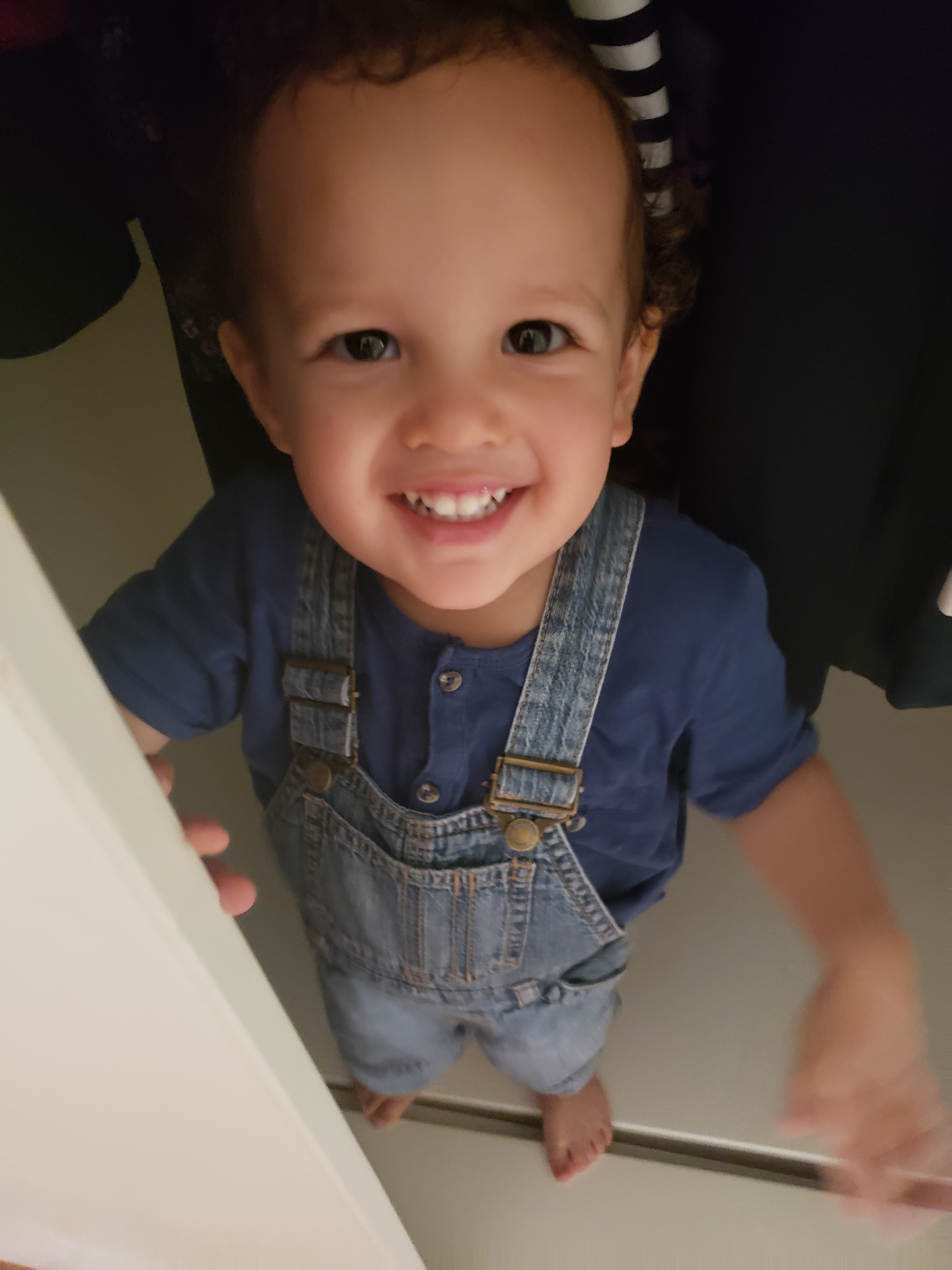
My hands trembling, I click on the article to read what journalists have written about my boy. The article mentioned a few facts about the explosion, but otherwise is a straightforward re-telling of the media release put out by the Australian Embassy. When the Embassy caught wind that the media had somehow gotten hold of Isaac’s name and nationality, they advised us to get ahead of things by making a statement, which they drafted on our behalf. At their suggestion, I scrolled through my phone to find a photo of Isaac to accompany the statement. I picked one that I had taken a few weeks earlier. Isaac and I were playing hide and seek in our apartment. He loved hiding in my cupboard and wasn’t afraid of being alone in the dark. I snapped the shot as I opened the cupboard door, to find his beautiful face – big smile and sparkling dark eyes – looking up at me. He was wearing denim overalls and a navy t-shirt. You can just make out his mess of dark curls. For me, the photo represented a perfect moment in time – playing games with my boy without a care in the world. I had nowhere to be and nothing to do but be with him. And it represented so many things that I loved about Isaac, his big smile, his cheeky face, and his absolute confidence.
Against my better judgement, I scroll through the Facebook comments on the news article. When we had released the statement, I told my husband Craig that we should avoid reading the media coverage and that under no circumstances should we read any comments on Facebook or under any articles. It took less than a day for me to disregard my own advice. Many of the comments were kind and supportive but one completely stopped me in my tracks.
“He doesn’t look Australian”.
He doesn’t look Australian… what the hell is that supposed to mean? Because he isn’t white? I keep scrolling and soon descend the rabbit-hole of finding every single article online that mentions Isaac and obsessively reading the comments. Over and over again, scattered throughout the kind sentiments, are vile comments directed at my innocent son.
“He’s just some Lebanese kid”
“Why the fuck should we care about him. I bet his Leb parents just came to Australia to bludge off Centrelink”
“Who cares about the son of terrorists”.
Suddenly, I felt very sick and I bolted to the bathroom to throw up. I didn’t understand. How could people look at Isaac’s photo – the photo of a two-year-old, the photo of a dead child – and their first thought is to hurl racist insults at him? From the moment he was born, I braced myself for the racism that Isaac would inevitably encounter. But I never, not for a moment, expected to experience it in his death.
Isaac looked nothing like me. He was a carbon copy of his Dad. Same wild curls, same deep brown eyes that were each slightly different shapes, same rosebud lips, same crooked smile. When you look at photos of Isaac side-by-side with photos of his Dad as a young boy, even I struggled to tell them apart. It was clear he was Eurasian, just like his Dad. The only indication that Isaac was my son, that he had inherited any of my genes, was the fact that he was a little bit fairer than Craig. Instead of black hair, Isaac’s was dark brown, instead of dark brown skin, Isaac’s was a deep olive – although it quickly turned brown in the sun. But put him next to me – with my fair skin, blonde hair and light blue eyes – there was no telling that he was my son. I used to love sitting with him in between my legs and look at the contrast of our skin – mine so pale it is almost translucent, ugly blue veins peeking through, Isaac’s a beautiful caramel – and marvel at how this gorgeous little boy came from me.
It never bothered me that Isaac didn’t look anything like me, he was my boy and that was all that mattered. Craig used to say how beautiful it was that when Isaac looked at me, he didn’t see a woman who looked nothing like him. He just saw his Mum. Sometimes I even had to remind myself that Isaac was not an extension of myself, but was his own little person.
While I looked at Isaac and saw the most gorgeous, perfect boy, I knew that at some point in his life, he would probably experience racism. It was something I was not familiar with. Sexism, sure. But racism? My white skin had protected me from that. The closest I had ever come to getting a glimpse of what it was like to be on the receiving end of racist taunts was one night out in New York City. Craig and I were meeting friends to attend a film festival in the chic neighbourhood of Chelsea. While sitting at the window seat of a café waiting for our friends, we noticed a man stumbling along the street, clearly drunk. We paid him no mind – it was not an uncommon sight on a Friday night in the city – but suddenly, he was standing over our table, swaying and struggling to maintain his footing. I was heavily pregnant with Isaac and immediately stiffened. He ignored me though and, wobbling on his feet, got right up into Craig’s face and shouted – in slurred, somewhat incoherent speech – that he was a “traitor” for “fucking a white woman”. I was in an absolute panic, ready to run. But Craig, cool as a cucumber, ignored the obscenities and spittle flying from this man’s mouth and kept talking to me like nothing was happening. While this guy was essentially having a go at me, I wasn’t on the receiving end – Craig was – but he maintained his composure. He had dealt with this type of thing before. Craig had told me stories of the relentless racism he endured at his conservative boarding school in Perth and the mark that left on him. Day in day out he endured relentless taunts and jibes that occasionally descended into violence. He learned when to push back and when to stay silent. The man eventually shuffled off, no doubt to accost some other poor passerby, and I could tell as soon as he left that Craig was shaken. I worried for him, but I also cradled my pregnant belly, concerned about what my unborn child may have to face one day and even more cognisant of the fact that my lack of experience in dealing with racism – while an absolute privilege – had left me unprepared to deal with what might come his way.
When Isaac was 15 months old, my work transferred me from New York to Beirut. Before we made the move, I read about the prevalence of racism towards Asian people in Lebanon and worried about what Isaac may encounter. Luckily, it never came to pass. In fact, wherever we went, Isaac was greeted like a little Rockstar. Walking around the city, it was not uncommon to see groups of men, young and old, sitting together on plastic chairs, drinking coffee, smoking and chatting. As a woman, it is the type of gathering I am trained to avoid. Cross the street, don’t make eye contact, ignore any lewd comments they may call out at you. But walking around with Isaac was a different story. These men, with their calloused hands and gruff exteriors, turned to putty when Isaac came past, waving, trying to tousle his hair and give him sweets. Isaac lapped it up, waving to them as though he was an Emperor greeting his subjects. At our local café, Isaac soon became one of the family. No matter how busy it was, the staff Moe, Maria and Ahmed, always had time for him. They carried him around while taking orders from customers. He joined them behind the counter and in the kitchen. We practically had to beg them to stop giving him free gelato. We started worrying that Isaac would get a big head with all the attention, particularly since boys are still so favoured in this patriarchal society, and we talked about what we would do to counteract the issue. But that was a problem for later on. For the moment, we accepted the warm embrace of the Lebanese people and we were grateful for the love they showed our little boy. In the absence of our own family, we were never concerned that he was not receiving the love and attention he deserved and any concerns about racism were carried off with the wind.
Until the explosion.
Days after Isaac’s name and photo were reported in the media, and the racist comments started to emerge, The West Australian ran a story titled “Australian Beirut victim Isaac Oehlers’ father revealed as Christ Church Grammar school graduate Craig Oehlers”. The article featured a photo of Craig and I that they had found online. It was a selfie we had taken many years prior when we lived in Sydney. We were standing on the street outside our apartment in Neutral Bay, on our way my birthday lunch in the city. I had just had my hair done. I wanted subtle highlights to cover up some grey hair poking through and I remember the hairdresser had gone a shade or two blonder than my usual colour.
The paper’s exclusive take was that Craig had attended one of Perth’s most expensive and prestigious private schools. We wondered how Craig’s schooling could be of any possible interest or relevance to Isaac’s death – they didn’t dig up any background information on me.
Then it hit us.
This article, in this conservative newspaper, was subtly saying – look, Isaac wasn’t some Lebanese kid from western Sydney. His Dad may not be white, but he is one of us. He must come from a “good” family if he went to an exclusive private school that produced a bevy of high-profile businessmen, Chief Justices, and sportsmen.
Perhaps it was a long bow to draw. Perhaps we were putting intentions into the journalist’s words that were not there. But one thing we know, after it is revealed that Isaac had a white mother, and his father came from an elite background, the racist comments about Isaac start to subside. Instead any vitriol is directed squarely at us.
“What were they doing in Lebanon?”
“What the hell do you expect if you go to Lebanon?”
“What kind of parents would take their child to Lebanon?”
“Some people shouldn’t be allowed to have kids”.
The comments hurt – these people did not understand our life and our decisions and to have our love and care for Isaac questioned was brutal. And the racial angle was loud and clear. While they were no longer racist towards Isaac, they clearly questioned why we would take our child to “That Place” – the place of war and terrorists and Muslims. But I anticipated these comments about Lebanon. Because I had seen and heard that before. Cronulla riots, terrorist raids, Islamophobia. They had all conditioned me to expect people to think we were crazy for accepting a job in Beirut. I knew that anything to do with the Middle East brought out the worst in many people and put their ignorance on display and I had seen glimpses of it from the moment we announced we were moving to Beirut. But at the end of the day, I could – shamefully – brush it off, because it was not really about me. Such was my privilege. But I never expected that same racism to be projected onto my own child in his death.
As I write this, I feel kind of silly about the shock I felt in that moment. About the shock I continue to feel when I think about it. Because, this is not some massive revelation. There is no doubt that systemic racism influences about how we care for victims. We see it all the time. It doesn’t matter if the victim is two, like Isaac, or 20 or 80. We saw it in the global reactions to the war in Ukraine, where pundit after pundit expressed shock that a European country had been invaded, that people “like us” could find themselves fleeing their homes or dying in the streets. At home, we see it in the lack of outrage at Indigenous kids dying in custody and in the contempt for refugees – adults and children alike – who die at sea trying to reach Australia. While the racism directed to Isaac in his death is very personal, it is not isolated or unusual.
The racist insults hurled at Isaac awakened me to the privilege I carry in ways that I hadn’t been aware of before – to the idea that privilege extends even in death. As time goes on, this awareness became even more acute as I started to experience the other side of the coin, when Isaac became somewhat of a poster child for the blast. At two years and three months, Isaac was, according to official records, the youngest victim of the blast. Another young girl, three-year-old Alexandra, was the youngest Lebanese victim and she quickly became an icon. A photo of Alexandra in pink overalls, grey tshirt and brown sandals, her shock of beautiful curls crowning her head, is splashed across newspapers across the world. She is standing in front of the Mohammad Al-Amin Mosque, one of the most well recognised sites in Beirut, waving a Lebanese flag during the 2019 anti-government protests. A time when revolution was in the air. The image is a symbol of the hope felt at that time, the hope for future generations, a hope that was quickly snuffed out. Her parents Paul and Tracy – educated, articulate, fluent in English and, in Tracy’s case, a dual Lebanese-Canadian citizen – become two of the most prominent spokespersons for the victims of the explosion and the fight against the corruption that led to the blast.
But Isaac’s name is often mentioned in the same breath as Alexandra’s, his photo placed side-by-side with hers. His name appears in Lebanese media, as well as in newspapers across the Middle East, Europe, the US and Australia. I am often interviewed for the same news articles as Paul and Tracy. According to early official records, only three children were killed in the blast – Isaac, Alexandra and 15-year-old Elias Khoury. It is fact repeated in the media and one I took at face value.
Together, Isaac, Alexandra and Elias galvanise people to action. Lebanese citizens, people I have never met, carry Isaac’s photo and wear his face on t-shirts in their regular protests for justice. Artists depict Isaac in their work honouring the victims. A portrait of Isaac sells for $16,000 at a charity auction. A sculpture inspired by Isaac and Alexandra is put on permanent display at the Institute of the Arab World in Paris. A memorial swing bearing Isaac’s name is erected in the grounds of Sursock Museum, down the street from our old apartment. A kind benefactor installs a park bench in Isaac’s name in gardens where he used to chase butterflies and search for cats. The support shown to us by strangers, and the great efforts they go to in order to honour his memory and fight for justice on his behalf, is humbling and comforting.
It is not until a year later, on the first anniversary of the explosion, that I learn that more than three children lost their lives. I am interviewed for an Al Jazeera article on the child victims of the explosion and expect it to be about Isaac, Alexandra and Elias, as others have been. But when the article is published, another name is prominent – Bissan Tibati, a seven-year-old girl from Syria. As I read the article, I feel overwhelming shame creep in, like a hot, red rash engulfing my face. How could I have not known about Bissan? How have I spent the last year talking about the three children killed in the explosion without checking if there were others? The article interviews Bissan’s father. He and his family had left Syria five years earlier to secure a safer life for Bissan and her younger brother. She was injured in the explosion by a piece of shrapnel and died seven days later. Her father says, “I have a portrait of her on the wall, and I look at her while I have my morning coffee. And then I hear her voice saying ‘Dad, please help me,’ but I can’t help her.”
As I read these words, I burst into sobs. Our lives in Beirut could not have been more different – me, a well-off expat living in one of the most prestigious suburbs of Beirut while working for an international organisation; him, a refugee, living in one of the poorest neighbourhoods, supporting his family by working as a mechanic. Me, knowing our lives in Beirut were temporary and that we would eventually return to the comfort of Australia. Him, also living a temporary existence but with no end date, no knowledge of what would come next. And yet, I feel his pain as if it is my own. Because it is my own. On that day, the glass and debris didn’t discriminate. It hit young and old, rich and poor alike.
But while the blast itself did not discriminate, the world’s reaction to the victims certainly did. Bissan came from a Syrian refugee family, a clear underclass in Lebanese society (and many societies). Her death does not generate the same level of attention, at least in the English-language media, as Isaac and Alexandra’s. I Google Bissan’s name and come up with no more than a handful of English language results – the Al Jazeera article and a couple of mentions in Lebanese publications. In contrast, a search of Isaac’s name returns hundreds of results – Al Jazeera, France24, BBC, Sky News, New York Post, The Guardian, numerous Australian and Middle Eastern publications, and many more. His story generated interest in a way that Bissan’s did not, and yet the tragedy of their deaths is the same, the pain felt by her parents is the same pain we feel.
The Al Jazeera article that featured Bissan’s father also mentions that up to seven children were killed in the blast, the youngest only five months old. It is well known that the official death toll is incomplete, with refugees and migrant workers the most likely to be left off the list. Seeing Bissan’s beautiful face, reading some of her story, and spurred on by the shame that I feel for not seeing past official propaganda about the blast victims that placed my own son front and centre, I become determined to learn about all of the children killed in the blast.
I approach a Lebanese journalist that I know through a United Nations colleague. She runs an independent publication and I recall seeing her mention on Twitter that they are investigating the real death toll. She kindly sends me their working list of victims, noting that according to their records, at least 10 children were killed. I carefully comb through the list and pull out their names:
Alexandra Naggear (Lebanese, 3)
Isaac Oehlers (Australian, 2)
Elias Khoury (Lebanese, 15)
Cedra Kenno (Syrian, 15)
Zoulbab/Jolbab Sajid Ali (Pakistani, 14)
Joud Hajj Steif (Syrian, 13)
Mohamad Yaser Salibi (Lebanese, 17)
Kousay Fadi Ramadan (Syrian, 5 months)
Bissan Tibati (Syrian, 7)
Ahmad Khaled Al Mahmoud (Syrian, 10)
Hala Ibrahim Abdulrahman (Syrian, 7)
One by one, I Google their names to learn what I can about them. And one by one, I come up with very little. Most of the information comes from a project by a Lebanese NGO that sought to record all of the victims. From this, I learn that Mohamad Yaser Salibi was recovering in hospital from a car accident when the explosion hit, destroying the hospital.
I learn that Joud Hajj Steif was a Syrian refugee who dreamed of becoming a teacher and was killed in her home along with her mother and sister.
I learn that Zoulbab Sajid Ali wanted to be a basketball player and that he was playing his Playstation when the explosion hit.
I learn that Cedra Kenno was a Syrian refugee whose family of seven lived in a single room near the Port of Beirut. She dreamed of returning to school but that dream was never realised.
And I learn that five-month-old Kousay Fadi Ramadan was born with a severe liver disease and was in hospital when he died.
The other children are mentioned in unofficial lists of victims, but there is no detail about who they were, what they were like, how they died, or who their families are.
I am most intrigued by Kousay Fadi Ramadan, the five-month-old boy who was killed. Over and over again I had heard that Isaac was the youngest victim of the blast. It was a line that I had repeated ad nauseam, a line we had inscribed on the memorial swing erected in his honour near our Beirut apartment, without actually checking whether it was true. To find out that an infant had died, threw me. Digging a little further, I learn that Kousay is not included on the official death toll because officials claimed he was so sick that he was going to die anyway. His own doctor accused his parents of lying about Kousay’s cause of death in order to get money from the Government. His parents claim that while he was indeed incredibly sick, it was the explosion itself that killed him.
I can help but feel that if Kousay wasn’t Syrian, the cause of his death would not be in question. In July 2021, a Lebanese politician proposed a law to exclude non-Lebanese victims of the explosion from the State’s compensation plan. An article on the Bill mentions my family as one that would be disadvantaged under the proposed law. But I know that it is not targeted at us, it is targeted at families like Kousay’s, families like Bissan’s. The government does not want to take one iota of responsibility for Syrian refugees, the Palestinian refugees or the migrant workers from Bangladesh, the Philippines and Ethiopia, killed that day. They seek to bury their existence and their memory.
I can’t imagine how that feels for those families. I admit that I seek comfort in the fact that Isaac is one of the most well-known victims. That the people of Lebanon – and the world – know his name and his face. The only thing that could make his death worse is the idea that he could be a faceless, nameless victim in this atrocity. That he could be forgotten.
But with his status, comes increasing weight of expectation. Alexandra is held up as such an icon of the explosion that her father clearly reminds the public that she is not a martyr, but a victim. I too start to experience what it is like for Isaac’s image and story to be co-opted into the fight, not just for justice, but for wholesale change in Lebanon. During the Parliamentary elections, numerous people contact me to tell me they are voting for Isaac. And as I speak out in the media about the need for an international investigation, I am contacted by numerous other victims thanking me. They tell me that the world will listen to me, to Isaac’s story, in a way that it will not listen to the Lebanese victims. I know exactly what they are trying to say – that the world will care more about the son of a white UN employee, than Lebanese people. They fervently hope that Isaac’s story – the story of an Australian child killed in the blast – would spur the Western nations into action. One man goes a step further and tells me he believes that Isaac died in the explosion in order to bring international attention to what happened that day.
It makes me feel both uncomfortable and angry. As Isaac’s mother, I feel a duty to seek justice for his death. I expected to spend a lifetime taking care of him, and after his death, this is all that is left for me to do. I am grateful his story resonates with so many and we can use his memory in a positive way. But I bristle at the notion that he was destined to die in order to bring change and justice to Lebanon – a country that was not his own. He was only two-years-old. His only job was to play, learn and have fun, not bring about a revolution.
On the other hand, I am angry on behalf of my Lebanese friends who feel that the world has either forgotten them, or just doesn’t care. I know it is true that my profile as a Western woman means I am more likely to be listened to, and I feel a heavy duty to keep fighting to bring attention to their plight. But I also struggle with the idea of speaking on behalf of Lebanese people. I only spent a year in the country, and I will never go back. While I am very clear about what I want in terms of justice for Isaac, I don’t want to presume that people in Lebanon feel the same.
And, as much as I want Isaac to be known by everyone, I cannot forget the shame I felt at learning there were other child victims. I simultaneously want Isaac to be front-and-centre, while also not wanting his story to overshadow the stories of other children. When Isaac first died, I caught a glimpse of what it was like for people to not care about him based on their racial biases, I don’t want to be part of anything that does the same thing – either implicitly or explicitly – to other children.
I struggle to know when to use my voice and when to be silent. When do I use my privilege to fight for justice and to remind the world of what happened in Beirut, remind them of the other victims who have been forgotten, and when do I step back and insist they be allowed to speak for themselves? As a mother, I want to scream Isaac’s name from the rooftops and take every opportunity to fight on his behalf. But as a mother, I also do not want to silence other mothers, to take up so much space that their children are forgotten. It is a difficult line to tread and one that I am still coming to terms with.
So, what does this white woman having an epiphany about the fact that racism continues after death add to the conversation? Nothing really – except to say how sheltered, nay privileged, I have been all my life. I can only accept my own failings in being unable to recognise the fact that privilege extends well beyond death until it literally slapped me in the face. And I can only try and use those lessons to do better for all the child victims of the explosion. To fight for Isaac, but also for Alexandra, Elias, Cedra, Zoulbab, Joud, Mohamad, Kousay, Bissan, Ahmad and Hala.
This is a slightly edited version of an essay that received Runner-up in the Narrative Non-Fiction category of the 2022 Lord Mayor’s Creative Writing Awards. The Judges feedback was:
“A bracing account of both expat life and what life within Australia is like, commenting on the ubiquitous impacts of white privilege as well as the experience of being Other for the very first time. Interlacing personal testimony and political commentary, the essay is raw and robust, pulling readers back with potent emotion and to a moment in time.“
 Sarah Yvonne